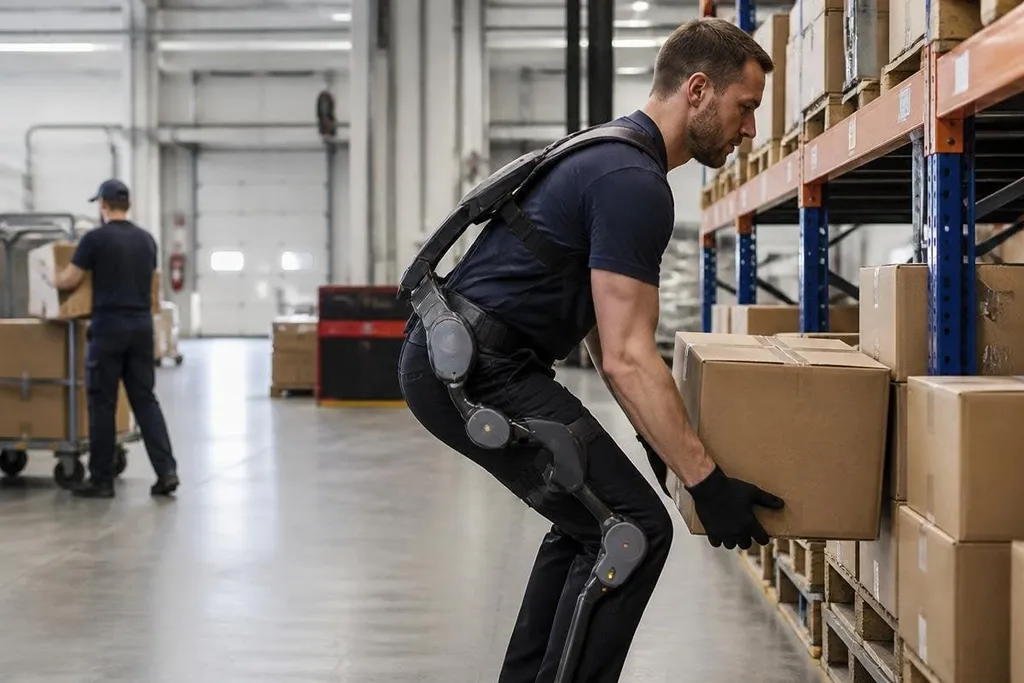
A robotic exoskeleton can move with a worker and take some load from their back, legs, or arms. That makes the technology relevant wherever people repeat heavy lifts, hold tools overhead, or work in bent positions for long periods.
The case for exoskeletons rests on a practical question: can they reduce physical strain without slowing the job or adding new risks?
- Passive frames use springs or mechanical parts instead of motors.
- Powered models add motors, batteries, and sensors.
- Fit, task design, and training decide whether the system helps.
What an exoskeleton changes
An exoskeleton is a wearable frame that follows the body’s movement. A back-support model can shift part of a lift’s load from the lower back toward the legs and hips, while an arm-support model can hold some tool weight during overhead work.
That shift matters because the worker still controls the task. The frame does not carry the person through the job like a mobile robot. It adds force at selected joints, so the design must match the movement people already make.
Passive systems store energy in springs or other mechanical parts as the worker bends, then return some of that energy during the lift. They tend to be lighter and easier to maintain than powered systems, but the same support can feel awkward when the worker walks, climbs, or reaches in a different direction.
Powered systems use motors to add force. Sensors read joint movement or body position, and a controller decides when to assist. That can give a wider range of help, but it also brings batteries, charging, software faults, and more parts against the body.
Why companies are paying attention
Many industrial tasks repeat the same body motion for hours. A worker may lift parts from a low bin, hold a drill above shoulder height, or carry a load across a short work area.
The wearable frame may reduce the effort of one part of that task, which can make the work less tiring over a shift. That does not mean it removes the need for safer work design.
A lift table, better part placement, or a smaller load may fix the cause more directly. An exoskeleton fits best when the task still needs a person and other changes cannot remove the physical demand.
A trial needs the task, load, and wear time beside its result. Industrial exoskeleton reports from Robot24.com can put those details in one place before the next section looks at where the exoskeleton reaches its limits.
Where the limits show up
Fit is the first test. A frame that presses against the hips, restricts a worker’s stride, or slips during a lift can create a new problem. Workers also need time to learn how the device reacts before using it around tools, vehicles, or other people.
The task matters just as much. A back-support frame may help during repeated bending, then become a poor fit when the job involves ladders, tight spaces, or frequent turns. Arm support can reduce shoulder effort during overhead work, yet it may restrict fast hand movement when the task changes.
Powered units add a battery limit. A shift that lasts longer than the battery needs a charging plan or a spare pack. The buyer also has to check cleaning, service, software updates, emergency release, and what happens when the motor or sensor stops working.
The open question is long-term use. A short trial can show that a worker feels less strain during one task. It cannot, by itself, prove fewer injuries, higher output, or lower costs across a full operation.
A buying check for work sites
Use this list before asking for a trial unit:
- Name the motion: record the lift, reach, bend, or hold that causes the strain.
- Measure the task: note load weight, repetition, work height, shift length, and walking distance.
- Test the full route: include turns, steps, tool changes, breaks, and emergency movement.
- Check the body fit: inspect pressure points, range of motion, heat, and clothing clearance.
- Plan the service work: confirm battery time, charging, cleaning, repair, and worker training.
I'd choose an exoskeleton after changing the work area first, not before. The wearable frame should handle a remaining task that needs human judgment and movement.
Robotic exoskeletons matter more as factories, warehouses, and care settings look for ways to keep people in physically demanding jobs. Their value will be decided by safe daily use, not by a motor count or a polished trial video.